Showing posts with label winter. Show all posts

Sunday, December 28, 2025

Winter Seed Sowing - The Finalists

I've been immersing myself in YouTube videos and Reddit threads about winter sowing, and I think I've made my mind up which seeds I'll try for the first year.  

I have leftover Whorled Milkweed, which didn't fare so well last year when started in the house. I'd really like to get this established in the meadow area.

Teasel, which I discovered can be invasive so I didn't even crack that seed envelope.  If I only sow a few, grow them in pots, and cut back the seed heads before they naturally distribute, I may be safe.  They are a nice structural plant.   

Annual asters (Sea Star mix) are apparently good candidates for winter sowing, and I have about half of a package left from last year.  

I have a package and a half of Rococo blend pansies and I'm trying to decide if I want to winter sow them in containers or sprinkle them around the cottage gardens and between beds in the hillside garden.  These are seeds I purchased in 2023 and started indoors, then transplanted out in containers.  They were spectacular, and when autumn rolled around I'd neglected to empty a small pot of them.  To my utter shock, they came back the next year in that pot and thrived. They reappeared last year, as well.  We'll see if the seeds are still viable.

I'm going to try winter sowing some cool weather greens, too.  I have cabbage, kale, and spinach that I'll attempt to coax to life.  I sowed cabbage seeds last year directly in one of the shadier raised beds and they were not much more than an inch tall by the end of the season.  I sowed spinach directly in a bed twice and both times it failed to even germinate. I think our springs are getting too warm too quickly, and it's affecting these crops.  Hopefully this will give them an edge and get them started in optimal conditions.

All of these seed packets were purchased for previous years, so I'm not 100% confident they'll even germinate, but you never know.  I grew Roma tomatoes from the same seed packet for four years previously, so it's worth a try.  Next step: deciding on the actual containers.  

Addendum - after I hit publish I realized I have other seed packets already in the fridge to keep them cool!  Great Burnet, Verbena bonariensis, Valerian, and side oats; the latter two I also sowed directly in the meadow back in late November.  I have a number of seeds I collected from the gardens, too.  Clematis, Vervain, Ragged Robin, Poppy, Mallow, and Penstemon.  Looks like I'm going to need more containers than I had bargained for!

Sunday, December 21, 2025

The more things change

 Talk about what's old being new again...I was going through some of my winter posts from years gone by, and noted how similar the December 2022 post regarding a rain storm was to a storm we just experienced this week.  Thankfully the 2025 warm up with rain and wind wasn't as destructive, but it sure did eat up all of our Christmas snow.  The fog created by the warm air made for some moody photos, too.


 I love how the pre vs post sunrise light changes in photos; the blue tinted snaps were taken about an hour before the more sepia hued ones. 

In the end, the warm air and heavy rain melted most of the snow and temperatures then dove into the lower 20sF, so everything froze solid.  The winter that we experienced Winter Storm Elliot ended up being extremely snowy after that storm, so maybe we'll return to a winter wonderland before it's over with.  I mean, it's only the first day of winter, so who knows what's in store? 

Sunday, December 14, 2025

garden ruminations and the fix


As I sit here on a snowy December day, my thoughts turn to vegetable growing.  I fully admit that I start with a bang during spring months that are so filled with promise.  Like an echo, that initial push of excitement fades into the distance as the reality of growing conditions, my own mistakes, and unpreventable climate or weather related mishaps begin rearing their ugly heads.  The hot summer months are when I begin to look around and adopt a defeatist attitude about my gardens.  This isn't a healthy pattern, so I need to fix it.

I've been looking at my simple garden layout and thinking about what has worked well in which beds, what has failed miserably, and figuring out the why of it all.  


 I developed this layout initially to keep track of my perennial stock; to determine which plants I had in which beds.  As I moved the perennials out, I thought this chart would help me determine simple crop rotation for vegetables.  That didn't work because I tend to use any open spot as a perennial holding area for new plants, plants I've started from seed, or plants that need a specific growing condition that I haven't prepared yet, thus throwing my rotation plans into chaos. So what other uses might this chart have?  How about light, and where to better plant specific vegetables according to their need for sun or shade?

This chart is situated as though I'm standing at the bottom of the hill, in the entrance.  The top is fairly west, the left is fairly south, the bottom fairly east, and the right fairly north.  It's not exact, but it's also not evenly split.  The left side of the garden is shaded by the large trees of the forest garden from around noontime to three or four o'clock, then it's hit with full sun for a few hours until sundown.  The right side of the garden gets pretty much full sun all day.  Using this information, I can determine which vegetables will do better in which beds.  Well, you would think, anyway.  Last year I tried growing lettuce in the old tub at the very bottom left, and it was a massive failure.  Likewise, radish and cabbage in the far upper left did almost nothing.  I'm not sure if it was light conditions or if the soil was missing something, but I may revamp those beds altogether and try again.  

Since adding the hay ring in the center, I've been frustrated by the way one side of whatever I've planted at the base of the ring - peas, cucumbers, or pumpkins - grows better than the other.  I've been thinking of adding more trellises in the hillside garden for vining vegetables, and thought...gee, do the trellises need to be a certain position for optimal output?  Well, duh, young Skywalker, they sure do.  The hay ring is positioned east to west; that is, walking through the open center you are moving east to west, with plants on the north and south sides. In this situation, one side gets more sun and grows faster and better than the other.  Trellises should be positioned north to south, so they get the full benefit of light on both sides as the sun traverses the sky.  I'd like to add vertical trellises (and possibly arched) for cucumbers, peas, and possibly some smaller squash varieties.  My beds are all lined so that if I start in one row and bend a trellis up to the next row for arched, they should work great, with the open center running north to south and veg planted on the east and west sides.  If I go with just a vertical wall type trellis the length of the beds, I already know that works because I've done that in the past with a small piece of hog panel.  

My next thought is that if add trellises, I need to know which beds will best lend themselves to the potential shading of afternoon sun from the vining plants.  A quick check on "what vegetables benefit from afternoon shade" led me down a rabbit hole of confusing information.  The internet.  At once the most and least helpful informational tool.  So what do I know to be true?  I know cool season crops need sun but don't thrive in heat, and many can be coaxed through the summer by providing some cooling shade.   

Armed with this information, I'm now going back to my trusty seed box to take stock of what seeds I have on hand, which ones need to be scrapped due to age, which can be started inside, which can be direct sown, and what plants I'm better off letting the garden center start for me.


 Who says gardening in northern climes stops when the beds are buried under snow?


Friday, December 5, 2025

Good gravy, it's winter!

 And just like that, everything was covered in snow.


It's funny that most people I talk to are astounded by how "soon" winter arrived.  It's December in New England - we're lucky we didn't have a white Thanksgiving!  

So my to-do list isn't quite ta-done.  I didn't get any more fence posts in, I didn't get any fencing up, I didn't get more brush cut in the forest garden area, or cut the sumac whips behind the bitch barn (my alternative to a she shed).  I guess all of these shift over to the spring to-do list, once the snow is gone.  So much to get done next year, what with the alpine garden, maintenance in the hillside garden, and the continuing formation of the forest garden.  I really need to set my expectations to a level more acceptable to a mature woman's abilities.  That's a nice way of saying I'm old and broken, and can't bull like I used to.

In the house I've started some more lettuce, another tomato, and another pepper.  Hopefully the aphid invasion was stemmed in time.  I ended up tossing some old friends on the compost heap, figuring they may have been the culprits that brought aphids in the house.  Goodbye to my four year old celery plant, my five year old parsley, and a few annual flowers I've overwintered.  I always feel like I'm abandoning a pet when I purposely cull plants.  The guilt can be overwhelming, which is half the reason I overwinter things I shouldn't.  

This winter, I'm going to try winter sowing in plastic jugs, and I'm excited to see how it pans out.  Last winter, I stratified seeds in the fridge and then grew them under the grow lights.  I really didn't have the best success; the fame flowers died before I could get them planted out, the five poppy mallows that survived are planted in a holding bed and I'm not sure they'll make it, the whorled milkweed that germinated died soon after planting out, and the gaura never did much.  The coneflowers did really well, but the ones I planted out into the meadow area struggled, and I'm not even sure if they made it.  The leftovers that I planted into the cement bed in the hillside garden thrived despite the lack of water, so hopefully I'll be able to transplant those out next summer.  

I'm thinking this year I can concentrate on annual flower and vegetable seed starting in the house.  I need to curb my enthusiasm so I don't overplant and wind up with no room to spread out under the lights once I begin to pot on when the seedlings get too big for their containers.

Looking ahead to my outdoor gardening new year, I hope to get the back yard finally fenced in.  Once that's complete, I can start laying out the garden beds and pathways.  I've been researching paths, because I don't want to make the same mistake I did with the gravel paths that were eaten by grass within one season.  My biggest mistake may have been the landscape fabric barrier, believe it or not.   I think I'll start with mown grass paths, and go from there.  Of course, there are the prerequisite chores that need to be done first, so that I can do the fun stuff...get the alpine bed situated, because once fenced I won't be able to get the tractor in there.  Get more mulch on the bank, because once fenced, I won't be able to back my truck up to unload.  Ugh.  Who knew a simple garden would be so much work?  I did, because I never make these things simple!  But I honestly believe I thrive on this stuff.


Friday, February 28, 2025

It Feels Springish

 And just as quickly as the switch was flipped to cold, it's been flipped to hey, it's above freezing!  Not exactly beach weather, but boy howdy, snow is melting.  Though it's going to be a while yet before I can get into the hillside garden.


I'm happy to see the two small dogwood trees are still in good shape; they're those sticks poking through the snow just to the left of the bottom of the hay ring.  These are free range Pagoda Dogwoods, which are native to New England and are abundant on our property.  These two were found as four inch seedlings and transferred to pots to grow on. It's not a great idea to leave them like that in our climate; if the pots freeze solid, there's a chance the roots will get killed.  I generally try to bury pots in the ground over winter to insulate them, but these are extra large buckets and the thought of digging a hole for them was too much.  Hopefully the snow is enough insulation.

In the house, things are popping up like crazy.  The seeds I sowed on February 18th are doing well despite the mold issues.


 Only the globe thistle seeds that I pulled from someone's garden didn't germinate, so overall I feel like this is a win.

The gaura seeds were the worst affected by mold and the ones I gave a diluted bleach bath.  There were supposed to be 100 seeds in the package and I think I'll be lucky if I get a dozen to plant out.


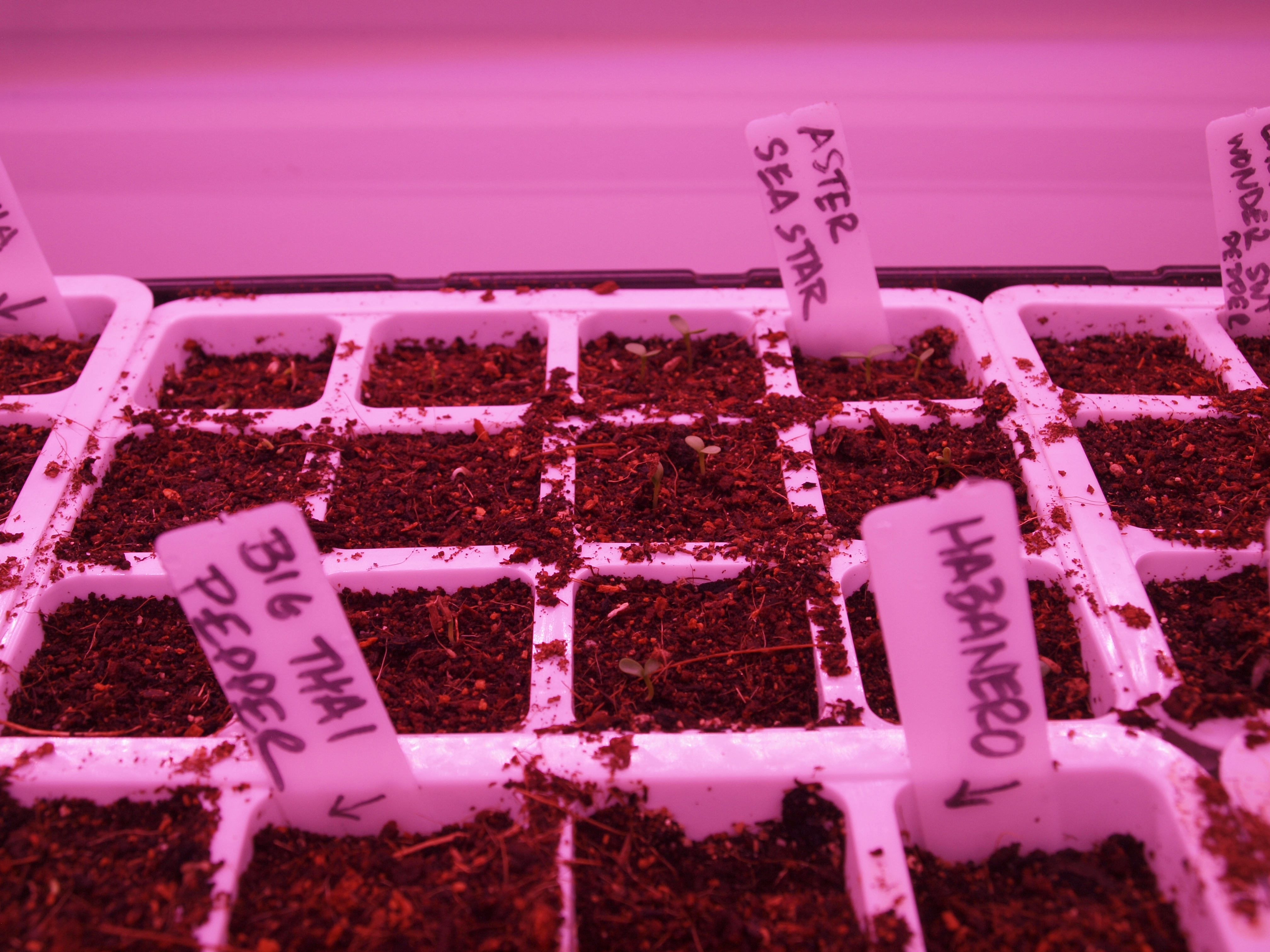
 On February 23rd I sowed some aster and petunia seeds.  I used the new trays and also sowed 3 kinds of hot peppers, sweet peppers, and three kinds of tomato.  The asters and tomatoes popped right up, but the peppers are just barely breaking through the soil and the petunias are so tiny, I can barely see them.

tomatoes

aster

petunia

A word of caution...I've noticed the last few years that I've been seed starting in the house that there's a particularly sour odor that permeates the air.  My house smells really stale right now, and slightly like there's a soiled diaper lurking in a corner.  I think it's a combination of the damp soils and general lack of fresh air.  I'd start these all downstairs in the mudroom, but I love checking them every day and fussing over them, so that's not going to happen.  I recommend a clothespin to the nose if visiting.

And lastly, the strangest thing is happening with the barn roof snow.  With the warmer temperatures and the melting, the snow slides down the roof as usual, but when it hits the snow stoppers it acts like a bolt of cloth being unrolled, and begins to fold up on itself.  It's so bizarre!

(how cute are those mules, though?)
 

I don't know how much will bank up behind the stops before it melts off, but I'm hoping it all goes before the next cold snap.  As an old Yankee used to say to me, it's not melting, it's just making room for more snow.

Wednesday, February 19, 2025

Be Careful What You Wish For

 Well now.  February blew in with some snow.  How much?  So far this month, it's this much.


That's my old bathtub under all that mess!

The nice thing has been that each storm was fairly manageable; between 3 - 6 inches of snow, and most of the time very light, fluffy stuff.  That's because it's been freaking FREEZING this winter.  The last storm could have been worse; they were calling for 6-8 inches of snow followed by sleet and freezing rain.  Luckily, we avoided the freezing rain and ended up with about 2 inches of granular sleet on top of about 8 inches of snow, packing it down to about 6 inches of dense mess.  Unluckily, the storm left us with 40-60 MPH wind gusts, which made cleanup...interesting.

While my brush cutting project has been waylaid, I have been hauling manure to the mound surrounding the wildflower meadow.  Now I'm committed to that project because I don't want a stinky layer of manure outside my back door all summer.   Planting the corn out back frees up the cinder block bed for something different, and I'm thinking of planting my onions and carrots there this year, as these are companion plants.  Companion planting the right plants together can help deter pests and boost growth; in some cases the plants each rely on a different nutrient that the other produces or doesn't leech from the soil.  Mixing in certain herbs or flowers with vegetables can work as well as mixing different crops together.  

Inside, I've started some leeks from seeds I harvested from the plants that went over last year.  I had about a 50% germination rate, so I'm happy!  We don't use a lot of leeks, so growing just a dozen or more plants will give us the small harvest we want, and will free up one or two beds.  


The mescluns and arugula continue to grow, but not by leaps and bounds as it would outside.


 The lower container of spicy mesclun mix was already harvested once, so that's regrowth.

I also pulled the 60 day stratified seeds out of the fridge to sow.  To my dismay, most of my packages had begun to develop mold.  A quick trip down an internet rabbit hole has convinced me to not use the paper towel plastic bag method next year.  Apparently mold is all too common.  Some people have noted they've planted the moldy seeds and had decent germination, and others recommended a quick bath in watered down bleach (10:1), which is what I did for the worst affected. I sowed most of the seeds in the flimsy black plastic seed starting trays I normally use...you know, the ones that break apart when you try to remove the seedlings.


 I was too impatient to wait for the newer models I'd ordered. 


I'm excited to try these - they're hard plastic top and bottom, with a flexible silicone center.  In theory you should be able to push on the hard bottom and pop the seedlings out without damaging the tray.  These are also dishwasher safe, so no excuses for not sterilizing them!  I bought them on Amazon, of course, and they come in a package of six trays that fit perfectly into a standard bottom tray.  These are the smallest version, and I'm thinking if they work as well as advertised, I may invest in some larger squared ones for potting up when seedlings are ready.

 And what method do I think I'll try next year instead of the paper towel/bag?  Outdoor winter sowing.  I just need to find someone who drinks milk to give me the plastic jugs!

Sunday, January 26, 2025

Safety first update

 A few posts ago, I talked about the snow stops I had installed on the barn roof, and how they performed in a small snow storm that involved a changeover to rain.  Last weekend we had a storm that left behind six inches of fluffy snow - our biggest storm this season.  I know, it's been a lackluster winter as far as snowfall.  At any rate, I was able to gauge the effectiveness of the snow stoppers a little better this time.  They don't work quite as well as I'd hoped, but I'm still glad I had them installed.

 On the hay room side of the barn I figured the non-stoppered roof snow would give way much quicker, but it appears it came down all at once, despite the guards over the hay room door. The snow definitely spread farther where it wasn't slowed by the stoppers, but it still packed down like cement despite that.


On the mule's side, it was the same thing.  The snow came off all at once and formed a packed mound in the paddock.


I've marked the second photo - the yellow indicates the area I had run the snowblower through, to open it up.  The snow from the roof landed in a mound between the blue lines; at least it blew out farther away from the barn wall than it normally would if the stoppers weren't involved.  And luckily, it wasn't a massive load of snow by the time it came down.  This just makes me think that with deeper snow loads, I shouldn't assume I'll be safe under the eaves.  I have to admit I was a little surprised the snow still came off like this.

Completely safe, on the other hand, are the greens I started earlier this month.  

I started another sowing of arugula and mesclun mix (sweet this time) about two weeks after the first sowing.  I'm completely addicted to the arugula, and can stand there picking the tiny leaves off and eating them for far too long. I don't know if they'll ever get the chance to mature at this rate.  

As January comes to a close, I have two more weeks to wait before I can sow my stratified seeds and see how they do.  I've also ordered some last minute items like seed potatoes, sweet corn seed, and more mini cucumber seeds in preparation for the garden this year.  I've been hauling manure out back to the mound, so I'm definitely going to be planting squash out there, and hopefully corn.   I'm feeling optimistic about the coming season...let's hope it lasts into spring.


Monday, January 20, 2025

What Little Progress

 It's been colder than normal in these here parts, so my plan to clear a little bit of the forest garden every day was delayed.  When it was actually above freezing, I managed a small bit of clearing behind the leaf mold cage.  


It looks ok now, but what you can't see on the ground are the bittersweet and Virginia Creeper vines snaking about the forest floor.  With the leaves, acorns, and other detritus frozen to the ground, the finer cleanup will have to wait for spring.  This doesn't look like much, but it was three hours of snipping, lopping, untangling, and in the end four manure sled loads of brush went over the hill and into the pit of Out of Sight, Out of Mind.  That's where most of my brush ends up that isn't usable in other projects.

Shout out to these gadgets - I wouldn't be without them.  I use them to pick up leaves, thick piles of grass left by the mower, waste hay in the mule paddock, and piles of small brush.  


 With so much of the brush I'm currently cutting being brambles, these make picking up the thorny cuttings much less painful.  I've used other styles that were more square shaped, but these are my favorite.  

One more session on a mild day opened up even more space.  This time I transported most of the brush to the landfill.  I mean, do I really want those bittersweet vines re-rooting in my woods?  Not really.  After cleaning it up, I was so proud of how barren it looked.


Ah, there's nothing like a fresh six inch snowfall to prove you've missed a ton of small brush.


 I'll get all the fine stuff with the wheeled trimmer when I get it back.  In the meantime, I need to get my steps in by snowblowing my driveway.


 We're back into the deep freeze for the next week, so it looks like my brush clearing endeavor has been sidelined for now.  With this new snowpack, maybe I can actually get a little ski track laid out to keep the momentum going.  Maybe.  We'll see how things play out by next weekend.


Sunday, January 5, 2025

New Year, Old Me

 I haven't made any New Year resolutions; I never seem to stick to them.  This autumn I was put on blood pressure medication which made me feel like an utter failure.  I am terrible at weight loss (food is my kryptonite), so instead of vowing to diet, I decided I'm going to move more.  I'm using an old Fitbit tracker and making sure I'm at least getting the requisite 10,000 steps in, but I try to aim higher.  My average since August is 11,000+ steps per day.  I despise regimented exercise, so walking, gardening, and yard work are my motivating tools.  I was a little worried I would fall behind during winter, but so far we haven't really had a winter.


What little snow we did get in December was washed away in oddly warm temperatures with rain.  As soon as we flipped the calendar, we flipped the temperatures.  We're going to see pretty much a consistent daily pattern of mid 20sF during the day, with teens to single digits overnight for most of the month.  I'm a little more than worried about losing some of the late planted perennials if their root systems weren't well established, but we'll see how it goes.  I'm actually surprised by how much green can be found in the hillside garden and cottage beds right now.  I tried to mulch as much as I could, but I was really banking on a deep snow pack to insulate most of my beds. 


The lack of snow has given me the impetus to finally start cutting back the brush and invasive plants where my forest garden will be.  My wheeled weed wacker is currently being repaired, so I'm using loppers to work my way through the tangle of bittersweet, briars, and Autumn Olive saplings.  


So far I've managed to cut back the small area in front of the wheel barrow.  It's not as easy as you'd think, not with the ground frozen completely solid and much of the debris stuck fast to the dirt.


It's not something I'll get done in a day, but I think by plugging away at it at least a half hour each day, I should get most of it cleared in a short time.  And it gets me moving, which is my bigger goal.  

I had also started cutting back the sumac whips behind the dogwood garden in the front.  My main reason was because I absolutely love seeing the sun set the Midwinter Fire bark aglow, and the sumac behind it was a distraction.


 Although, the sun behind the fuzzy sumac whips is beautiful in its own way.

Behind the house, it's been cold enough to freeze my little water feature solid.  I never did get around to putting a flagstone path between it and the fire pit area.


Speaking of the fire pit area, I'm rethinking the wall of asters I planted along the edge.  I think I may move them elsewhere, and plant something smaller along that edge, or leave it so the granite edging can be admired.  The asters also detract from the Yellow Twig Dogwood, which needs a serious pruning and maybe a new location.  


I don't cut back the asters because I've noticed the smaller birds going for the seed heads at times, and I like to encourage foraging.  Unfortunately I forget to pinch them back and they get leggy, which means they flop when the snow comes.  Unsightly!  

One last movement inducing task this winter will be hauling my daily mule manure to the wildflower mound.  This was something I've been wanting to do for two years now, but never got around to cutting back all the weeds and grass first. Unfortunately, Reputa suffered a broken throttle cable and a failed tube in one of her tires, so she is down for the count right now.  Pushing a wheelbarrow full of fresh poo across the farm twice daily in the pitch dark will be a good way to keep the step count up. Right?  I mean...right?  *cries softly*


 At this point, it's pretty well beat down and I can see what I'm doing.  The goal is to cover the slope with manure, then mulch heavily, and use this area to grow either corn or squash...or both.  Add in some pole beans, and I'll have a three sisters garden.  Not a bad idea!  Now, let's see if I can actually accomplish these tasks.  Full disclosure - no breaths will be held in the coming months.


Saturday, December 28, 2024

Yas, Green!

 The lights on the Christmas tree have barely cooled and it's already put away for next year, and my super cheap-o seed starting setup is humming in its place.  In addition to the seeds I began stratifying last week I have verbena bonariensis, globe artichoke, and teasel on the way, all of which need stratification. 


I know, right?

And because I can't help myself, I've already started some seeds. 


Mesclun mix greens, arugula, sweet basil, and spicy basil.  Just a little somethin', somethin' to tide me over for the next...*checks calendar*...53 days.

Sunday, December 15, 2024

Safety first!

 We just had a storm much like the one of December 26th, 2022.  We had some decent snowpack started, then in came absurdly warm temperatures and rain, followed by a deep freeze.  It was a good time to observe how well the snow guards I recently had installed on the mule barn roof worked.  After all, I didn't want a repeat of the April snowstorm near-death experience.

I opted for clear polycarbonate snow guards  and was happy with how unobtrusive they looked after installation.  We had a few small storms with three inches of snow or so, and above where they were installed, the snow pretty much stayed put.  The foot or so between the bottom row and the roof edge would just slide off, but that wasn't enough snow to cause injury to the mules, who for some reason insist on backing up to the eave side wall on the outside of the barn during bad weather.  Maybe the rain or snow coming off the roof feels like a massage, who knows?  But given this predilection I've always worried that they would get hurt at some point if a large amount of snow gave way; experience is the mother of caution, or something like that.

After the first couple storms we had another small one that left about four inches of new snow, but reports were calling for an unusual increase in temperatures and some torrential rain, along with whipping winds.  I was curious to see if the rain would have any effect on the snow still piled on the roof, held back by the snow guards.  Would it remain there, would it slide off in one go, would it peel off in sections?  

December 11th, 8:30 am: The snow is covering the entire roof.


December 11th, 2:30 pm: It's been drizzling rain but temperatures remain in the 30sF, only the edge has been exposed.


December 11th, 5:30 pm: It's beginning to rain in earnest, and despite melting or compacting a bit, the snow hasn't gone anywhere.


December 13th, 8:00 am: Despite temperatures into the 50sF and torrential downpours on the 11th, there's still snow on the roof.  This was pretty much what it looked like the morning of the 12th but I forgot to take a photo.  Temperatures plummeted back into the 20sF during the day.


It's now the 15th and it looks pretty much the same.  So, despite melting and rain, it didn't come off in one giant sheet.  The amount that slides off the roof isn't enough to hurt the mules (or their person).  And the biggest surprise to me is the lack of the massive frozen bank under the eaves, the one that sometimes looks like this:


So suffice to say, I'm pretty darned happy with these little snow guards.  I was nervous picking manure under the eaves at first (hello, PTSD) but I know now that I have nothing to worry about, I'm perfectly safe from sudden avalanches.  And it helps that I purchased enough to also have some installed over the hay room doors on the other side of the barn, where I'd been buried this past spring.  Safety first!